Upload a question image and get the answer with every step shown.
Runs in your browser. No app, no extension. Sign up free with Google in one click.
Drop an image here, or click to upload
Supports JPEG, PNG, WebP, BMP, PDF — up to 10MB
Or click outside this box, then press Ctrl+V to paste a screenshot
Same image, other tools:Image to TextImage to ExcelImage TranslatorImage Captioning
Most tools stop at pulling the text out. This one reads the question and solves it.
An OCR tool hands you a paragraph you still have to paste somewhere else. This AI question solver reads the problem and returns the answer directly.
GRE quantitative comparison, GMAT, college engineering problem sets, professional licence exam calculations, and multiple-choice questions across subjects.
The AI homework solver returns the working, not just a final number, so you can check the method instead of trusting the result.
Made for computer-based tests. Paste a screenshot straight from your clipboard. Photos of printed or handwritten questions work too.
Drag and drop, click to upload, or paste a screenshot from your clipboard. JPEG, PNG, WebP, BMP, and PDF are supported.
The AI identifies the question, including formulas, tables and answer choices, then works through it.
You get the answer together with the reasoning behind it. Copy any part with one click.
EXAMPLES
Standardised tests, not homework worksheets. Every answer below was produced by this page — the same model, the same prompt you get.

AI ANSWER
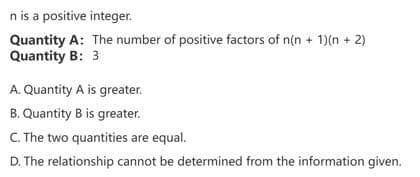
A. Quantity A is greater.
1. Understand the expression for Quantity A. It is the number of positive factors of the product of three consecutive positive integers, n(n + 1)(n + 2). 2. Consider the properties of the product of three consecutive integers. One of the integers must be a multiple of 3, and at least one of the integers must be a multiple of 2 (and possibly two of them). Therefore, the product n(n + 1)(n + 2) is always divisible by 2 and by 3, which means it is always divisible by 2 × 3 = 6. 3. Since n is a positive integer, the smallest possible value for n is 1. If n = 1, the product is 1 × (1 + 1) × (1 + 2) = 1 × 2 × 3 = 6. 4. The positive factors of 6 are 1, 2, 3, and 6. The number of positive factors of 6 is 4. In this case, Quantity A = 4. 5. For any positive integer n, the product n(n + 1)(n + 2) is always divisible by 6. This implies that 1, 2, 3, and 6 are always positive factors of n(n + 1)(n + 2). These are four distinct factors. 6. Therefore, the number of positive factors of n(n + 1)(n + 2) is always at least 4. 7. Comparing Quantity A (which is always ≥ 4) with Quantity B (which is 3), we find that Quantity A is always greater than Quantity B.

AI ANSWER
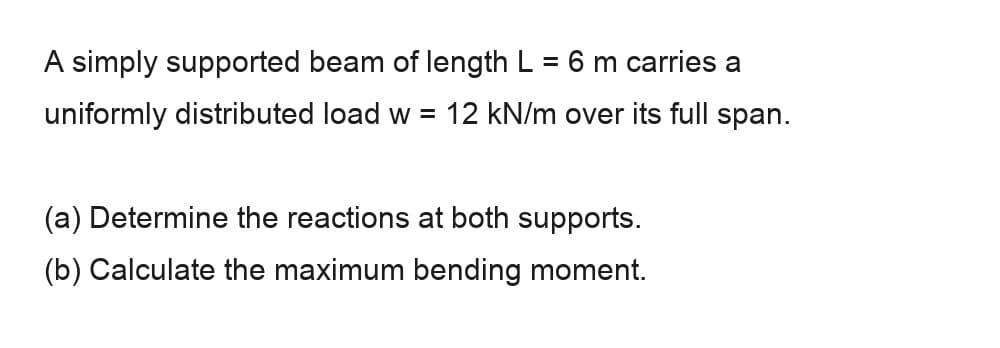
(a) Reactions at both supports = 36 kN (b) Maximum bending moment = 54 kNm
1. For a simply supported beam with a uniformly distributed load over its full span, the total downward load is the product of the load intensity and the beam length: Total Load = w × L = 12 kN/m × 6 m = 72 kN. 2. Due to symmetry, the reactions at both supports are equal. Each reaction is half of the total load: R_A = R_B = Total Load / 2 = 72 kN / 2 = 36 kN. 3. For a simply supported beam with a uniformly distributed load over its full span, the maximum bending moment occurs at the mid-span. The formula for the maximum bending moment is M_max = (w × L²) / 8. 4. Substitute the given values into the formula: M_max = (12 kN/m × (6 m)²) / 8. 5. Calculate the value: M_max = (12 × 36) / 8 = 432 / 8 = 54 kNm.

AI ANSWER
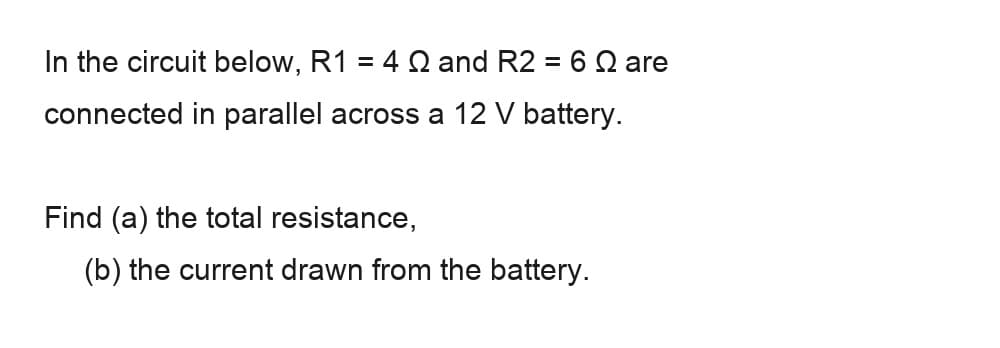
(a) 2.4 Ω (b) 5 A
1. To find the total resistance (R_total) of two resistors connected in parallel, use the formula R_total = (R1 × R2) / (R1 + R2). 2. Substitute the given values R1 = 4 Ω and R2 = 6 Ω into the formula: R_total = (4 Ω × 6 Ω) / (4 Ω + 6 Ω) = 24 Ω² / 10 Ω = 2.4 Ω. 3. To find the current drawn from the battery (I_total), use Ohm's Law, which states I_total = V / R_total. 4. Substitute the given battery voltage V = 12 V and the calculated total resistance R_total = 2.4 Ω into Ohm's Law: I_total = 12 V / 2.4 Ω = 5 A.

AI ANSWER
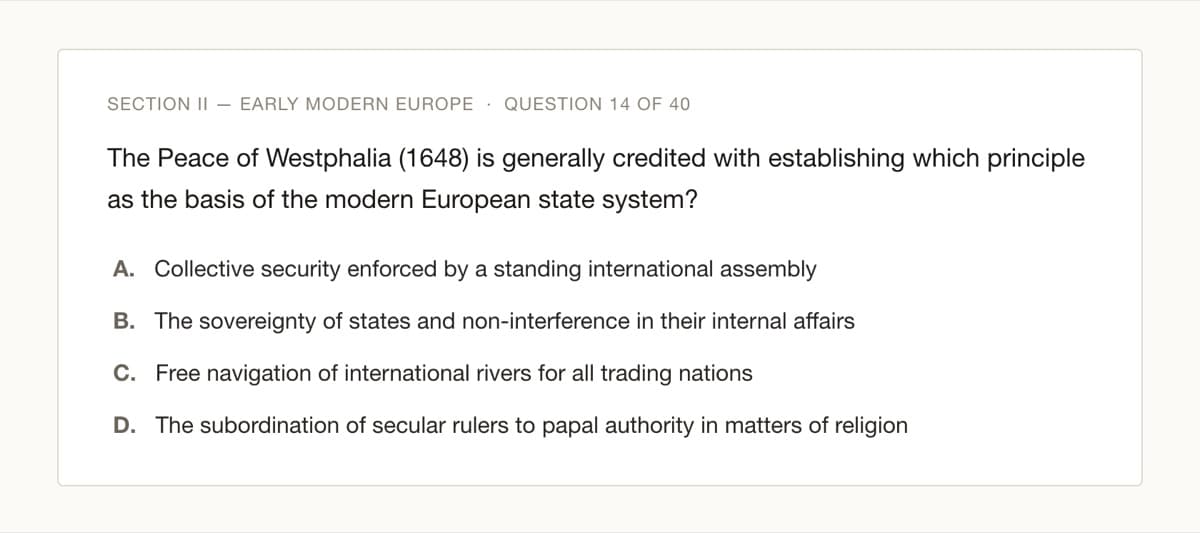
B. The sovereignty of states and non-interference in their internal affairs
1. The Peace of Westphalia, signed in 1648, ended the Thirty Years' War and the Eighty Years' War, fundamentally reshaping the political map of Europe. 2. A core outcome of these treaties was the recognition of the sovereignty of individual states, granting rulers the right to govern their territories without external interference, particularly in religious matters (cuius regio, eius religio). 3. This established the principle that each state had exclusive jurisdiction over its own territory and internal affairs, laying the groundwork for the modern international system based on sovereign states. 4. Option A describes collective security, a concept that emerged much later in the 20th century. Option C, while related to international relations, was not the primary foundational principle established by Westphalia for the state system. Option D is incorrect as the Peace of Westphalia significantly reduced papal and imperial authority, strengthening secular rulers.

AI ANSWER
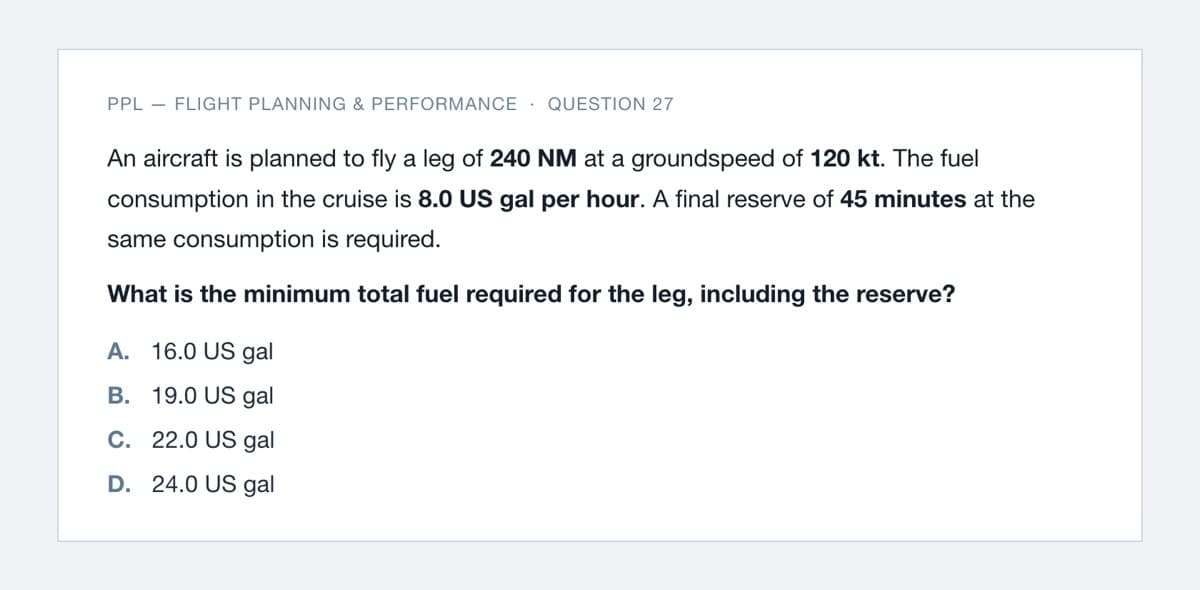
C. 22.0 US gal
1. Calculate the time required to fly the leg. Time = Distance / Groundspeed = 240 NM / 120 kt = 2 hours. 2. Calculate the fuel required for the leg. Fuel for leg = Time for leg × Fuel consumption rate = 2 hours × 8.0 US gal/hour = 16.0 US gal. 3. Calculate the fuel required for the 45-minute reserve. First, convert 45 minutes to hours: 45 minutes / 60 minutes/hour = 0.75 hours. 4. Calculate the fuel for the reserve. Fuel for reserve = Reserve time (in hours) × Fuel consumption rate = 0.75 hours × 8.0 US gal/hour = 6.0 US gal. 5. Calculate the total fuel required by adding the fuel for the leg and the fuel for the reserve. Total fuel = 16.0 US gal + 6.0 US gal = 22.0 US gal.
No credit card to try. No catch in the free tier. Upgrade only when you actually need to.
Pay once. Use it heavily. Walk away. No subscription, no auto-renewal.
Yes. Upload the image and the AI reads the question, including formulas, tables and answer choices, then returns the answer along with the steps that lead to it. You never need to retype anything.
That is exactly what this page is for. Typing out a maths or physics question is slow and easy to get wrong, so upload the picture and let the AI answer it.
Both, in that order. It reads what is in the image first, then answers it. If you only want the raw text with no answer, use our Image to Text tool instead.
Standardised test questions such as GRE quantitative comparison and GMAT, college maths and engineering problem sets, professional licence exam calculations, and multiple-choice questions in subjects like history and science.
Yes. Handwritten maths and neatly written notes are read well. Very messy handwriting or a low-resolution photo may reduce accuracy, so a clear, well-lit image gives the best result.
No. This AI homework helper runs entirely in your browser on any device. There is nothing to download and nothing to install.
Yes! A free account gets 3 free uses (3 per day). Sign up free with Google in one click. For unlimited use, upgrade to Pro starting at $4.9/month.